
Procrastination done well.

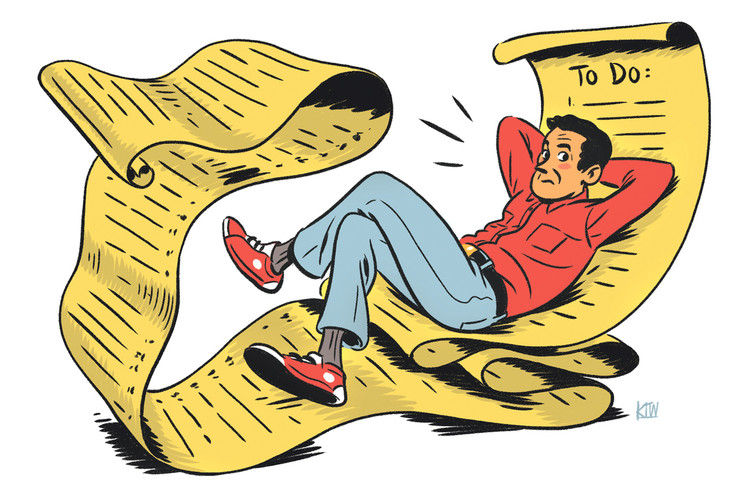
Most people who write about procrastination try to find the cure to it. But this, strictly speaking, is impossible. There are an infinite number of things you could be doing. No matter what you work on, you're not working on everything else. So the question is not how to avoid procrastination, but how to procrastinate well.
There are three variants of procrastination, depending on what you do instead of working on something. You could work on:
(A) nothing, (B) something less important, or (C) something more important. That last type, in my opinion, is procrastination done right.
This is the classic example of the "mad scientist", who forgets to groom his hair, leaves his markers lying around the lab, or even forgets to wash off that one chemical stain on his lab coat. His mind is absent in such scenarios because it's too busy trying to solve an incredibly peculiar question that could potentially be a groundbreaking discovery in the field of science. Most impressive and interesting people fall into the category C of procrastinators, they put off the "small stuff" to work on the "big stuff.
Conversely, forcing someone to perform errands, or the "small stuff", synchronously is bound to limit their productivity. The cost of an interruption between their fast moving train of thoughts is not just the time it takes, but that it breaks the time on either side in half. One probably only has to interrupt someone a couple times a day before they're unable to work on hard problems, or the "big stuff" at all.
Errands are so effective at killing great projects that a lot of people use them for that purpose. Someone who has decided to write a novel, for example, will suddenly find that the house needs cleaning. People who fail to write novels don't do it by sitting in front of a blank page for days without writing anything. They do it by feeding the cat, going out to buy something they need for their apartment, meeting a friend for coffee, constantly checking emails. "I don't have time to work," they say. And they don't; they've made sure of that.
One can't look a big problem too directly in the eye either. You have to approach it somewhat obliquely. But you have to adjust the line of sight just right: you have to be facing the big problem directly enough that you catch some of the thrill radiating from it, but not so much that it paralyzes you. You can tighten the angle once you get going, just as a sailboat can sail closer to the wind once it gets underway.
If one needs to work on the bigger things, they need to trick themselves into doing it. They have to work on small things that could cultivate into bigger things, or work successively on the larger picture, or split the moral load with collaborators. It's not a sign of weakness to depend on such tricks. Most of the very best works have been done this way, through the art of tricking oneself.
When I talk to people who have managed to make themselves work on big things, I learn that they all blew off the small stuff, and all feel guilty about it. I don't think they should feel guilty. There's more to do than anyone could. So someone doing the best work they can is inevitably going to leave a lot of errands undone. It ultimately feels like a mistake to sulk over.
I think the way to "solve" the problem of procrastination is to let delight pull you instead of making a to-do lists push you. Work on an ambitious project one really enjoys, and sail as close to the wind as you can, and you'll leave the right things undone.


Comments